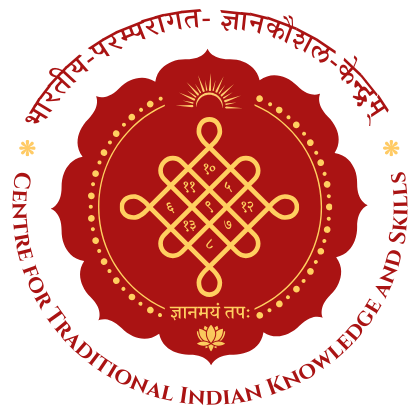
The emblem of the Centre for Traditional Indian Knowledge and Skills is conceived as a seal of continuity — where knowledge, skill, and lineage converge. It brings together three interwoven motifs: the padma (lotus), the kolam, and the Guru (Bṛhaspati) Yantra, each reflecting a dimension of India’s living intellectual heritage.
At the heart of the design blooms the lotus — a symbol of unfolding potential and clarity of thought. Surrounding it, the kolam evokes the quiet brilliance of knowledge woven into daily life: mathematics expressed as art, discipline expressed as grace. Embedded within is the Guru (Bṛhaspati) Yantra, a numerical magic square traditionally associated with the celestial preceptor. The harmonious structure of this Yantra signifies mentorship, expansion, and the ordered transmission of wisdom through paramparā.
Subtle solar and floral accents suggest illumination and renewal — the blossoming of traditional skills in contemporary contexts. Together, these elements speak of a tradition not frozen in the past, but alive in practice: precise, luminous, and ever-unfolding. Through this seal, CTIKS affirms its role as a guardian of that living continuity — where mastery is at once intellectually rigorous and soulfully embodied.
The guiding ethos of CTIKS is expressed in its motto: ज्ञानमयं तपः — often rendered as “Knowledge itself is austerity,” or more fully, “Knowledge as disciplined pursuit; learning as sacred transformation.” Yet the English word austerity does not adequately convey the depth of tapas, which in Sanskrit signifies not severity or deprivation, but a generative inner discipline — a refining heat that illuminates, strengthens, and transforms.
Derived from the verbal root tap (“to heat, to energise, to make radiant”), tapas is one of those Sanskrit terms whose philosophical and experiential resonance resists simple translation. Classical sources affirm this transformative power: “तपसा लभते सर्वं तथैवाध्ययनेन च” — through disciplined effort, and through study, one attains what is of highest value.
In this spirit, knowledge at CTIKS is not understood as the passive accumulation of information, but as the very substance that shapes and directs enquiry. The suffix -mayam signifies “constituted of” or “pervaded by,” suggesting that our scholarly effort (tapas) draws its strength, orientation, and purpose from knowledge itself. Such tapas is not withdrawal from the world, but a rigorous, value-informed mode of engagement — where intellectual precision, ethical responsibility, and aesthetic sensitivity converge to refine judgement and enable meaningful contribution to society.
The Centre for Traditional Indian Knowledge and Skills is envisioned to be a leading centre of
excellence dedicated to the rigorous study, reconstruction, and contemporary application of India’s
scientific and artisanal knowledge traditions. The Centre aspires to create a scholarly environment
where clarity of method, depth of inquiry, and integrity of interpretation are all seamlessly blended.
The Centre also seeks to contribute to a sustainable and humane future by nurturing forms of education
that unite analytical skill with cultural sensitivity, environmental awareness, and respect for the material
and intellectual labour embedded in traditional practices. Through the centre, we seek to strengthen
the foundations for responsible innovation and to ensure that the depth and diversity of India’s
knowledge traditions continue to inform, enrich, and inspire future generations.